Grayson’s Blue Goose
Grayson, Willard & Webbville · Northeastern Kentucky
Meet the gasoline-powered railcar that helped connect nearby communities and schoolchildren with Grayson.
Picture the working place.
Read each picture like a page from an old schoolbook. Match the numbered labels with the notes below, then compare the scene with the photographs and records.
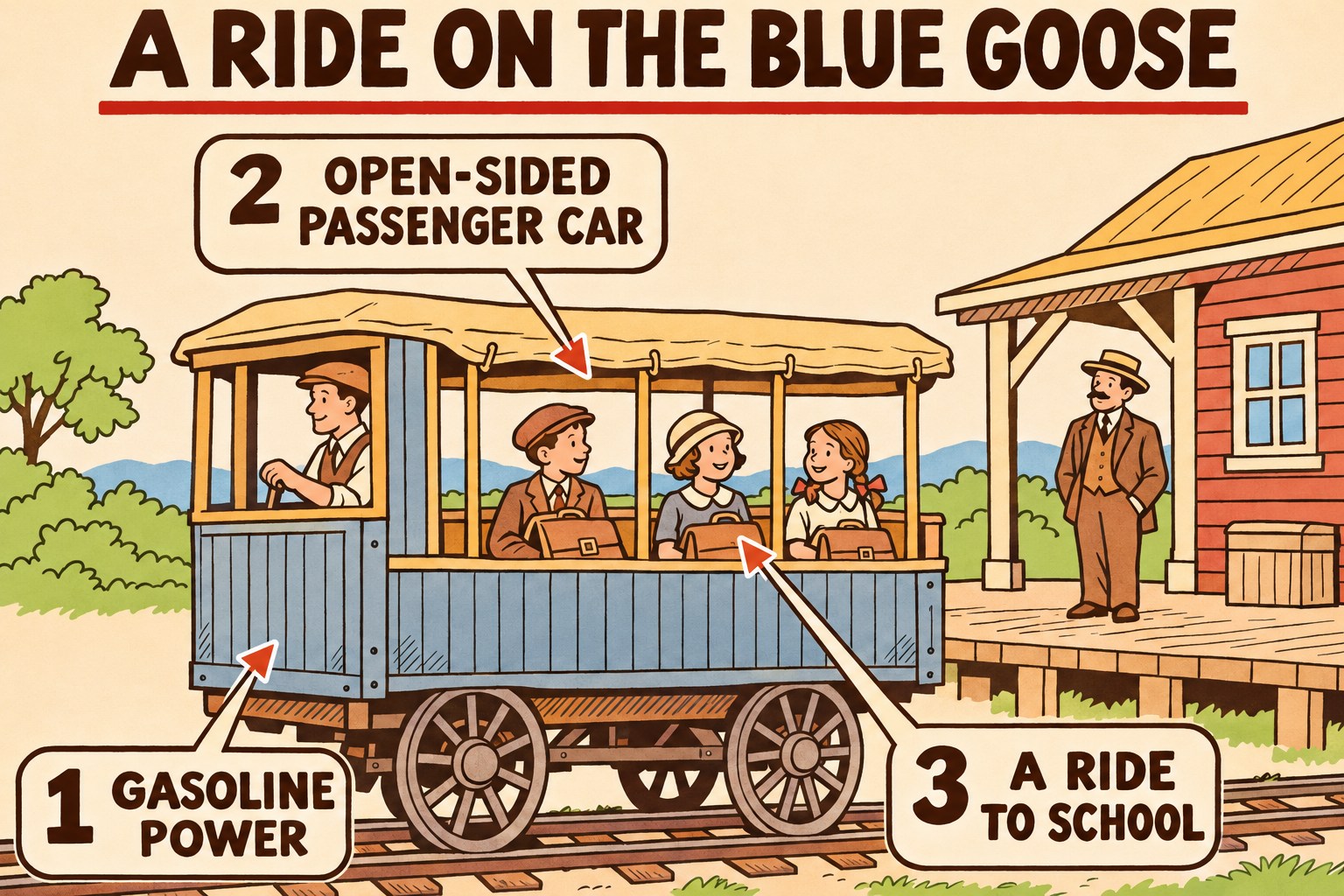
The Blue Goose: a ride to school
The Blue Goose connected communities with Grayson, including pupils traveling to school. This representative cartoon explains a gasoline railcar’s role. Its colors, vehicle details, and depot are illustrative, not a measured replica or a reconstruction of a particular day.
Open full illustrationLook for
- Gasoline power. The local archive describes a Ford Model T motor adapted for rail travel.
- Open-sided passenger car. Notice the canopy roof, open upper sides, and wheels on the rails.
- A ride to school. Imagine pupils traveling from their home communities to Grayson.
Modern AI-generated educational illustration. Created by the Restoring What Was Lost History Workshop.
Historical references: Carter County archive: the Blue Goose railcar · Kentucky Historical Society: Blue Goose school journeys
See the place.
Read the date and caption with each image. Historical photographs and modern aerial views show different parts of the story.
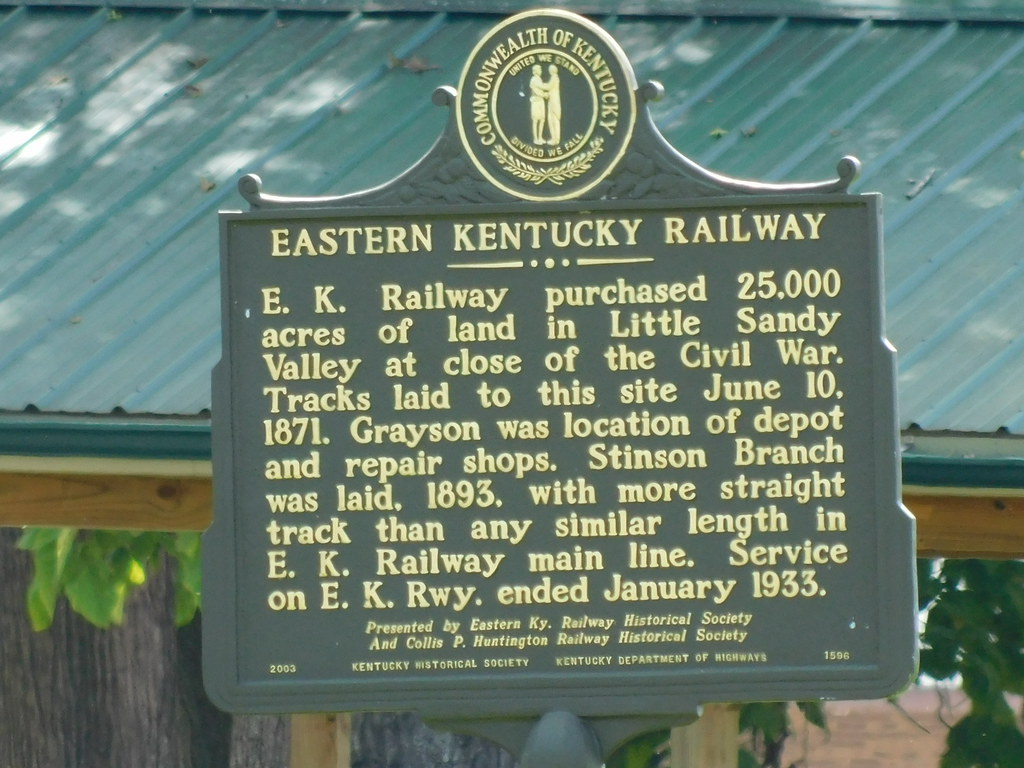
Grayson’s Eastern Kentucky Railway marker at the former depot area. This is a present-day reminder of the railway, not a photograph of the Blue Goose railcar.
Jimmy Emerson, DVM, September 6, 2021. Photograph reproduced unaltered. Original photograph ↗ · CC BY-NC-ND 2.0Find the place.
Use the former depot area to place the Blue Goose story in Grayson. The marker records the broader railway history; the original railcar and its replacement need to be identified separately in old photographs.
Loading the location map…
Grayson railway marker · former depot
The Eastern Kentucky Railway marker is recorded in the small park at the former depot on Carol Malone Boulevard, just north of East 2nd Street. The point identifies that marker and railway setting, not a surviving Blue Goose vehicle.
Marker location and coordinates ↗Pins identify the place described in each label. A historical marker or community pin may be separate from the original building. These are research locations, not confirmed visitor entrances.
Start with the record.
The Blue Goose was a gasoline-powered railcar on the Eastern Kentucky Railway route. Kentucky’s Webbville marker records two daily round trips to Grayson. Its Willard marker remembers children riding to school during the 1920s for $7.20 a month. This was the Grayson-area Blue Goose, distinct from the vehicle of the same name on the Morehead and North Fork Railroad.
Based on Kentucky Historical Society: Webbville, marker 2056; Kentucky Historical Society: Willard, marker 2301; Carter County archive: Southern Queen photograph correction.
A few moments in the story.
- 1871
Tracks reach Grayson
The Grayson marker dates the arrival of tracks at this site to June 10, 1871. The town had a depot and railway repair shops.
Eastern Kentucky Railway marker at Grayson ↗ - 1920s
A ride to school
Willard’s marker recalls pupils riding the Blue Goose to school for $7.20 per month.
Kentucky Historical Society, Willard marker ↗ - 1933
The railway’s service ends
The Grayson marker dates the railway’s closure to January 1933. This is a railway date, not a claim that the Blue Goose itself ran until then.
Eastern Kentucky Railway marker at Grayson ↗
How could a railcar change someone’s school day?
Use this explanatory drawing to investigate the idea. Choose an observation below the picture.
Choose a way to look closer
Read the relationship
Find Grayson, Willard, and Webbville. Trace the line in both directions.
This diagram shows a connection between places. Equal spacing on the drawing does not mean equal travel distances.
Notice. Sketch. Ask a better question.
Choose one prompt for a family conversation, or use all three as a classroom investigation.
Draw a school journey with three parts: home to the railcar, the rail ride, and the walk to school. Which parts are documented and which are your questions?
If a monthly fare was $7.20, what additional information would you need to estimate the fare per school day?
Write a careful caption for a historical photograph: what is certain, what is attributed to a source, and what remains unknown?
The lesson PDF pairs teaching notes with learner pages. Allow around 45 minutes for discussion and the activity, adapting the pace to your group. Model building, when chosen, takes additional time.
Download lesson: The Blue Goose: a route to schoolRead the sources.
Compare what a source says with what the diagram shows. Record uncertainties instead of filling them with guesses.
- Kentucky Historical Society: Webbville, marker 2056
Identifies the gasoline-powered Blue Goose and its two daily round trips to Grayson.
- Kentucky Historical Society: Willard, marker 2301
Documents the 1920s school journey and monthly fare.
- Carter County archive: Southern Queen photograph correction
Explains why a photograph formerly labeled Blue Goose is identified as the Southern Queen.
Help fill in the picture.
A family photograph, an old plant map, or a memory with a name and date can help us understand this place more clearly. Tell us what you know and where the information came from.
Share a history lead →Keep the connections going.
Created by the Restoring What Was Lost History Workshop.